
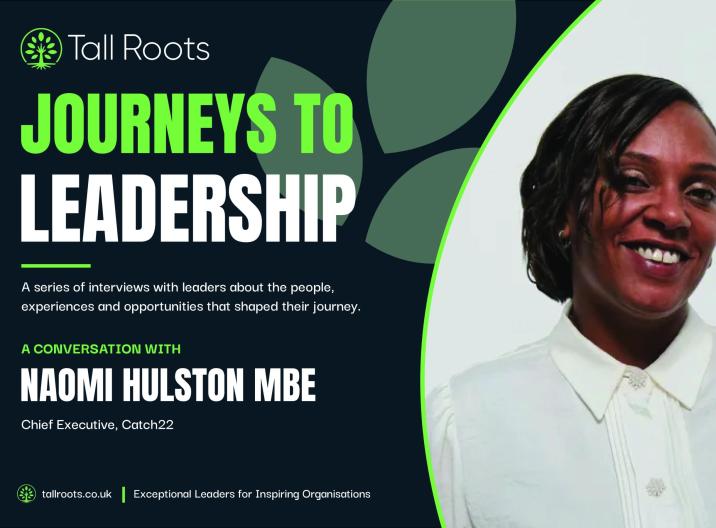
Journeys to Leadership: Naomi Hulston MBE, CEO of Catch22
Share this article
 LinkedIn
Date posted
14th October 2026
(15-minute read)
Naomi Hulston joined Catch22 at 17 as a volunteer running homework clubs. 21 years and 14 roles later, she is now Chief Executive. Within that time, she has held roles across business development, operational leadership, governance and organisational strategy.
We were delighted to speak to Naomi as part of our Journeys to Leadership series. In our discussion, Naomi talks about growing up in a biracial family and moving between Birmingham, West Sussex and London, the strong influence that her mum had on her, tackling imposter syndrome, what she has learnt about leading through change and who she thinks the sector is still overlooking.
-----------------------------
1. I’d love to start by finding out a little more about you. What was your background and life like growing up, and what first drew you towards working with young people and ultimately into the charity sector?
In terms of my earlier childhood and my life, I would say that I grew up between two very different cities and in two halves.
Until I was about eight, I grew up in the West Midlands, right in the middle of the Birmingham Superprix, and part of our memories were being around motor racing and cricket at Edgbaston. It was a very busy, vibrant, multicultural community and we were right in the heart of this bustling culture.
But then when I was eight, we moved to Crawley, West Sussex, as a result of domestic abuse. We're a biracial family that was living in a bustling city, so moving to Crawley in the mid-'90s was a total culture shock, as it was nowhere near as diverse.
Whilst we really loved the essence of Birmingham in terms of the mixture of cultures, Crawley was really serene, and we just had a really cool, chilled childhood. You could ride your bikes and play by the rivers, and there was just no worry or fear. So, it was kind of protective in a sense, but also very sheltered.
By the time I was a teenager, the reality of being a multicultural family living in West Sussex meant it was really difficult to find the things that we needed growing up. For instance, my mum would always have to travel out of town to get hair products for me because I needed certain types of oils. And eventually she just said, ‘look, let's just move to London’.
So, I came to London when I was about 13, and to be quite honest, I did not like it here. Being 13, I didn't see the soul and the opportunities that London brings. I just saw poverty and apathy, and it didn’t feel like people cared about each other, so it was hard to find a place to belong.
I felt like a really tiny fish in a great big sea. I went to school across London and didn't do very well. I ended up leaving school with very few GCSEs. I had a secondary education, but I just didn't pass the qualifications.
But I was determined to go to work. I was like, "I've got to make some money because my family was quite poor." And so I got a job in retail when I was 16.
I was also going to college at the same time to try to get some qualifications. I studied sociology, law and communication studies, but I ended up dropping out. I've never dropped out of anything, but college just wasn't for me.
My experience in retail was just hideous. It was great to have a little bit of money at 16 – I think I was paid £4.10 an hour – but the sexism that existed in that place was just awful.
My mum knew I was unhappy, and then she saw an article in the paper for the Prince's Trust personal development program, and she was like, ‘my kid's gotta go and find her soul’. My mum always knew I was quite talented and smart, but she also knew that the various changes, moves and instability of our family life hadn't helped me.
So she took me to the interview in her little red Astra, and then I ended up joining the 12-Week Prince's Trust personal development program, and it really got me thinking about what I wanted to do.
They said we had to go on a volunteer placement, and they found a Catch22 service in Elephant and Castle called ‘Kickstart’. I started off doing two three-hour sessions a week for homework clubs. I was terrified. I was 17 and these kids were 12 and 13, and I'd left school without any qualifications. I felt like a fraud, like ‘why am I helping these kids?’ I thought they were going to suss me out and realise that they're smarter than me.
But they kept coming back week after week going, "Oh, Miss, look at my grade!" Or, "Miss, look at what I did!" And I just started to really love it.
Eventually Catch22 asked if I wanted to do my Level 1 qualification in Youth Work. I was like, ‘what's youth work? I get a qualification and be paid for that?!’
I met an amazing group of friends at that point through a scheme called the Millennium Volunteers, where young people could earn awards for doing 100 or 200 hours of volunteering. Some of those people are still my best friends to this day; some of them still work for Catch22, and some of them have gone on to do great things.
Two out of us have got MBEs now, which is interesting! We came from some of the poorest estates in London.
I wouldn't say that I personally thought it was an obvious career choice, but my mum did, because of our background, the history with domestic abuse, and wanting to help people. So, she felt it was natural that I would end up in a helping profession.
My mum was definitely our biggest cheerleader. Her philosophy was that we should have a better life than she did. So even if she was hungry, we would still have good quality shoes on our feet. She would always put us first. And when she didn't have any money for petrol for the Astra, she still found enough to get us to those interviews or where we needed to go. She's the only person I've spoken to today, and she'll always be that person to me.
And how's the Astra doing? Probably not so well now!
It's funny because I have an Astra now! Everyone laughs at me, saying ‘you're a chief exec, why have you got a little broke-down Astra?!’
Because I like it, and I don't think you should necessarily waste your resources on something that erodes so much in value. But My mum laughs because she's like, you still love an Astra!
2. You joined Catch22 as a volunteer more than 20 years ago and have gone on to hold 14 different roles before becoming CEO. At what point did you first begin to see yourself as someone who could lead the organisation – and was there anyone in particular who helped you identify that potential in yourself and supported you in your journey?
In all fairness, I never really thought until right at the end that I would be Chief Executive of Catch22.
Imposter syndrome is huge, coming from the background I came from. My mum was really poor, my dad was poor. I only met my dad about ten years ago. I genuinely didn't have that kind of sense of self-belief.
It was only when I got to Chief Operating Officer, and Chris Wright (former Chief Executive, Catch22) would always say to me, “You're going to be Chief Exec one day." And I just thought he was chatting.
Would the Board pick me? Would the organisation support me? Would I be able to rise to the challenge at the moment when it came?
I never actually genuinely believed it until I actually got the job, if you want me to be honest.
Around Assistant Director level, I was told that I had the capability to lead, but you do wonder whether that's just people trying to boost you up rather than actually being genuinely real. And let's be honest, I'm a lady of colour. I am biracial. There are ceilings.
Even when I did get the job, I was like, ‘Are you sure? Did you get that right?!’
I would say that Chris was a massive inspiration. And obviously my mum.
3. You spoke about the feeling of imposter syndrome. Now that you are a CEO, do you feel more comfortable with that?
There was a period in my career when I really had to look at myself hard and say “you've got to change your narrative. What you used to think isn't true. You made it. You've earned this.”
You still get little pangs going into different types of environments. There'll always be an overwhelming sense of expectation and fear that you might get something wrong.
But what is wrong? You can always put mistakes right. But trying to hide who you are is more exhausting and hard work than just being yourself – that’s really helped me address that imposter syndrome.
Everybody's got a past. Everybody's got their experiences, and we're very quick to criticise – I think we could do more to be quick to praise.
4. There is a perception within the voluntary sector that if you want to move up, you move out. And so, it is rare to see someone progress from an entry-level or voluntary role all the way to CEO within the same organisation. What did Catch22 get right in creating those opportunities for you?
I think what Catch22 got right with me is to encourage me to diversify my skill base.
I started off as a youth worker, and they put a lot of investment into my education. As soon as I had done my Level 2 qualification, they asked me if I wanted to do my Level 3, 4 and 5 at Brunel University.
So, I actually went to university because of them. I worked full-time and did distant learning at weekends and evenings. It was exhausting looking back, but I didn't only get my diploma, I stayed on an extra two years and got my degree.
The Chief Executive used to always say the discipline of practice was theory. So, we were good at practice, but we needed the theory. They would always encourage that, and that's how I ended up with my degree.
Secondly, they encouraged me to diversify my skill base.
When the cuts came in 2011 for youth services, I didn't have a job. My service was closed in Islington, and Chris Wright and I had had several conversations back and forwards about how service design should work.
He called me up and asked if I was leaving. And I said, "Well, yeah, I haven't got a job. What do you want me to do?"
He said that there were some jobs in business development and that I should consider them.
I thought he was crazy! I don't want to work in business development – I wanted to work in the community with people. But he convinced me that I could help people by looking at how things are designed, and that I had the right mind for it.
I remember feeling like a kid going for the job because it was a skill base that I had never used before. It felt like I was going right back to the beginning.
But I ended up getting the job, and I learned how to become a business development manager. I learned how to tender. I learned how to build and design services, and how to do consultation.
And thirdly, I always felt that they listened to ideas and things that we had. So, if I had ideas about how you should design a service, I was allowed to be involved in that rather than just told, ‘Oh, thanks for your idea,’ and then somebody else would take credit for the work.
They care about you as a person and not just your skills and consuming what you've got to offer.
5. You’ve previously said that you never particularly had ambitions to become a CEO, but that you realised you needed to be in a senior position if you wanted to influence how public services were delivered. Having now been CEO for several years, what have you learned about leadership that you couldn’t have understood before you were sitting in the top job?
Before moving into senior leadership, I never truly understood the need for business architecture and to understand that whilst we've got our mission, and everybody wants to deliver the mission, charities are businesses just like any other.
And they need maintenance, they need servicing, they need taking care of. And that's the side I don't think that people really understand about leadership. They focus on the product, which for us is impact. But actually, the nuts and bolts that sit behind that is just as important.
So, I think my biggest learning curve was about what it takes to run a business and not just deliver the mission. I think they're two very distinct different things. Sometimes when you've got a very visionary CEO who's all about that influence, you can very easily allow an organisation inside to erode.
I think the discipline of leadership management and understanding business architecture and commerciality and all of that stuff, alongside your passion for the mission is the secret sauce. Nobody told me that though.
6. Catch22 has grown not only through its own services but by bringing other charities and organisations into the group. What have you learned as a leader about bringing organisations together and about leading through that kind of change?
It’s that old saying: ‘culture eats strategy for breakfast’. That is so true.
You can have the greatest strategy in the world, but if you do not have the right culture and you don't have the right set of values and the right kind of alignment, it will erode everything in seconds.
We're obsessed with the nuts and bolts of this stuff? But we don't spend enough time thinking about how the humans feel, how the humans are going to respond, how the humans are going to adapt, and whether they're going to agree or disagree.
So, I'd definitely say right up front, engagement and relationships with the people involved in this is probably the most important aspect of it all.
Secondly, is finding that space for shared alignment and being very intentional and clear up front that your priority is culture. If we can't align, we can't agree, we can't get on, then we're not going to be able to find the solutions in the systems that we need.
Going in it to get some economies of scale and achieve a cost reduction is naive.
Always start with the people and culture. Why are we doing this? What shared values do we have? What do we each want to get out of it? What are we going to do when we disagree?
Ask those hard questions. We seem to shy away from recognising that there can be conflict in anything, so why not ask about it upfront?
And I'd also be very clear about what each side's ambition is, and whether you do genuinely see one.
7. Your own career is a powerful example of what can happen when somebody is given opportunities to progress. When you look across the charity sector today, who do you think we are still overlooking when we think about future leaders – and what gets in the way of us seeing their potential?
There are two particular groups that I'm worried about.
One is people with disabilities. We’re just not good at engaging with, recruiting and employing people with physical disabilities in particular. And I just don't understand that. I don't get why we're not making more progress.
I went to an event at the House of Lords, and people who are blind, people who are deaf, people who have serious mobility issues have every set of knowledge and skills that we all have, but they still have very limited access to the workforce.
For me, in this day and age with tech, and with working from home, it's insane that we haven't done enough to move the dial. I know there has been some progress, but I just don't think there's been enough.
And then I think about schools. I visit schools all the time, and it's still not obvious. Where are all these children? And then they go on to become forgotten and hidden adults. So, I'd definitely say disability.
And it pains me to say this as a Black woman, but I’m also worried about the lack of Black and Asian men in leadership.
You look at other sectors, and you can see much more engagement. But in the charity sector, I only know a few. And I know some very, very talented Black and Asian men who can't break the ceiling.
I think Black women are making more progress in the sector than men. So, I would definitely say, when we’re looking at what role models are needed for the next generation, that we need to see more Black and Asian men in positions of power.
One of the things that I always found hard was the way I speak. Not being as eloquent and articulate as somebody who had a first-class education used to really bother me. And because of it, I would clip my speech and I wouldn't talk much.
So I wonder if it's about the way they communicate and elements of prejudice – I don't want to just call racism straight away, I think it's deeper than that and I think it's broader than that. I think it's about how they show up and how they're received.
Perhaps there is something psychological in there as well. You can rise above that prejudice and be strong, but it does a lot to your confidence. And when you've got to show up and perform with that in your head, knowing that you're already 20 points down, what that does to your performance in itself?
I'm not going to sit here and say I fully understand the reasons. If I did, I'd be out there solving it.
8. Finally, if you could speak to the Naomi who first arrived at Catch22 as a volunteer, what would you tell her about where that first opportunity might eventually lead – and what would you want other people starting out without an obvious route into leadership to take from your journey?
This is a difficult one to say because I feel like I'm betraying my gender, but I would say be less emotional and more logical?
There is a humongous space and place for emotional intelligence, and for all the feelings that we've talked about, like imposter syndrome. But actually, I don't think it helped me at times.
If I was more measured and logical in the way I thought about things, I probably would have saved myself a lot of agony in terms of worry and stress around each kind of stage and the processes that I went through.
I learned a lot later in life that my logical ability to reason was a lot stronger than my ability to be scared and to have fear.
That fear was driven from the emotion of not being good enough: I'm not this, I'm not that, I don't have a strong network, etc. But logically, I've come to realise that actually I do have a lot to offer.
Find a way to either get support and help from coaches or mentors, and think about how you can strengthen your logic and reasoning via reading, knowledge, exposure, experience, etc.
And I would say, when the doubt kicks in, have a fight with it. Push back on it. Because where does it come from?
Where that doubt is, where that fear and that worry and that stress comes in, find avenues to address it. Because it's wasted time and wasted energy.
You will most likely hear more positive than you will negative. So why are we allowing the negative to prevail, and not listening more to the positive?
And just believe in yourself. I'm not going to sit here and say everyone will make it, because that would be lying and that's not true. But diversify your skills as far as possible.
Some of the most interesting evolutions around learning how to be more commercial, learning about business architecture, learning about culture and people – those things have really helped me become the CEO I am today.
So if there's an area where you feel like you’re not so strong, then go out and overcome it. And in today's day and age, with the internet and everything like that, you can easily go and find out.
You’re not necessarily going to become an expert, but you can have a basic knowledge on things that you might not otherwise have felt as confident about.
So, nourish and nurture not only your emotional well-being but also your skills, knowledge and capability.
-----------------------------
Journeys to Leadership is a series of short interviews with leaders to understand the people, experiences and opportunities that shaped who they are today.
By sharing different leadership journeys from a range of CEOs, Director and consultants, we hope to inspire those who may not yet see themselves as leaders, or who may have hit barriers in their own journey to leadership, while also helping organisations to think differently about leadership potential.
Share this article
 LinkedIn
More Insights
-
 Insights
Let's talk about AI, authenticity and the privilege of writing well
- Read more
-
Date posted
20th May 2026
