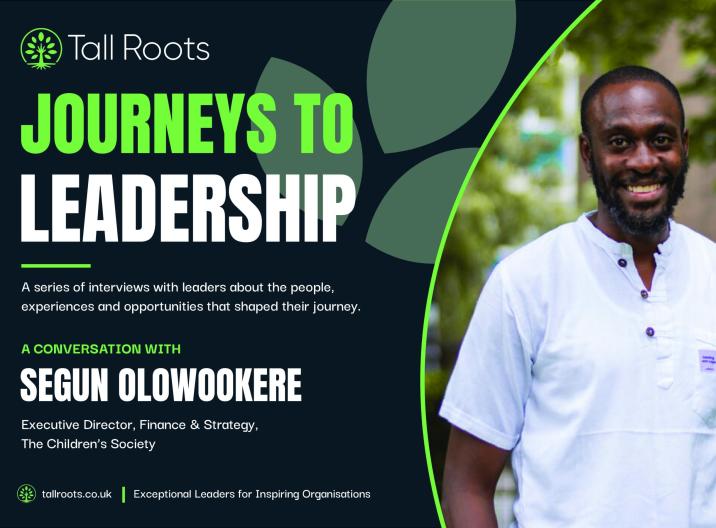
Journeys to Leadership: Segun Olowookere, Executive Director Finance & Strategy, The Children's Society
Share this article
 LinkedIn
Date posted
12th November 2026
What does it mean to lead with purpose, and how do we ensure that the next generation of leaders gets the opportunities and support they need to succeed?
We interviewed Segun Olowookere for our Journeys to Leadership series. Segun reflects on a leadership journey shaped by his experiences growing up in East London, the generosity of those who supported him and a determination to create opportunities for others. From his early route into the charity sector to becoming Chair of Blagrave Trust and Finance Director at The Children's Society, he shares how lived experience has influenced his approach to leadership and his sense of responsibility to give back.
We explore what organisations often overlook when identifying leadership potential, why leadership is about challenging the status quo rather than simply maintaining it, and the barriers that continue to limit the progression of Black leaders in the charity sector. Segun also discusses the importance of opening doors for young people, creating space for different voices and, as he puts it, remembering to “send the lift back down”.
---------------------------------------
1. I’d love to start by finding out a little more about you. What was life like growing up, and what were some of the experiences that shaped the person – and ultimately the leader – you became?
I was born in Hackney in the 1980s, which wasn't the Hackney that we see now. It was very rough. I actually lived on Murder Mile, as it was called back in the day, where unfortunately a lot of people died along a mile-long strip of road over a short period of time.
I was fostered as a baby alongside my sister and brother, and I was raised by my second mum, who was beautiful and amazing, such a light to the world and so generous. I think that is where my appetite and understanding of ‘giving back’ came from.
I think that has stayed with me through to today as a leader. That was definitely the seed that started it.
At the same time, I'm also second-generation Nigerian. I had frequent contact with my biological parents, who were based in Hackney, and then ended up living permanently with them from the age of ten. I went to an inner-city all-boys school, which I think is where my resilience comes from, which also comes into my leadership.
When I look at where I am now – and I'm a numbers guy, I like the numbers and the story that it is telling us – I don't even know what the probability is of me being in the position of where I am now, having the experiences that I have had. I think it's very, very, very low.
Ironically, and I know this is cliché, but I would do this for free. I do a lot of stuff voluntarily outside of my paid work because I just think it's so important. Providing young people with opportunities to fulfil their potential is a big part of what I do, and the organisations that I'm a leader in, because that was me.
I was never told that I could be here. So now that I am here, how do I pass that down?
That was where it came from, and it lives with me. It's part of me. It's not me switching it on to be part of the values of the organisations that I represent; it's just who I am. If I wasn't here, I would still be doing it in some other shape or form.
2. A lot of young black men growing up in Hackney at that time probably wouldn't have looked at the charity sector and thought, “That's where I want to work.” How did that come about for you? Was it a sector you knew much about?
I didn't actually know the charity sector existed, if I'm honest!
My plan was to become wealthy and then give my money away and help people, just as my mum had done growing up but without lots of money. I have also experienced how other people have been generous along the way.
My route to that was to go into investment banking, which again, I didn't know existed, but I was good at maths. I didn't make it as a footballer, so that was my plan B!
During university, I realised that banking wasn’t for me. This was way before the 2008 crash. If I'm honest, just waking up early and wearing a suit every day – that wasn't me. That just wasn't who I am. I'm lucky to have been self-aware enough to know that early on.
I was supposed to do a placement year at university, and I didn't find a placement. Again, I didn't know how to do that in the professional world. But I ended up doing some voluntary work as a finance intern for a think-tank, and that was my opening to this non-profit sector that I didn't know existed.
I was lucky to be mentored by a very generous line manager who came from the City. It was their first experience of working in the non-profit sector, and they helped open my mind to the opportunities that were out there.
Then, through hard work, learning and understanding the sector more, I've just taken it step by step to get to where I am now.
3. We first met back in 2017, when you were still relatively early into your leadership journey, and I recall you having a real sense of drive and ambition that seems to have followed you throughout your career. Where do you think that came from – and how much do you think nature versus nurture has played a role in it?
I think the ambition comes from my character.
Being a leader in today’s world is tough, if I'm honest, for anyone, no matter what background they are from. But growing up I could see so many issues and so many problems, and I think that's what I've learned to know is my unique perspective. Some people might call it lived experience. I call it my superpower. I've got a third eye to life.
That's where I think intersectionality comes in. I am a Black man that was raised in East London, who also spent a large portion of my early life in a predominantly white suburb in Cambridgeshire.
I've got a hunger to help as many young people as I possibly can influence, to get them the support that they need, because I've lived it and I've experienced it. I see and understand where they come from.
It's not stopping, and what we're doing isn't enough anyway. The fact that I've got the privilege to now be in positions of power, and influence, my aim is to absolutely maximise what we are able to do.
I don't think that's negotiable.
4. Ten years ago, you published your book, You Might As Well, in which you set out twelve principles for life. What is the biggest reflection you would want someone to take away from that book? And now, a decade on, is there anything you reflect on differently?
I wrote that book because at the time I was travelling a lot, so I had a lot of time on aeroplanes and space to think, and I was experiencing meeting new people and cultures around the world.
I just felt so overwhelmed by the opportunities that I had, and the growth that I had been able to experience within myself, that I felt the need to put it down and share it. That was the motivation for the book.
The first chapter is, “You might as well live your dreams.”
I generally feel that I've got a lot more dreams that I would still like to live, but I think that's the start. What someone might think is impossible is possible. But you have to dream it at the start. You have to imagine it.
To be fair, I'm cheating a little bit because, as I said earlier, I had a dream but it's not necessarily living out the way that I saw it in terms of helping people. I thought I'd be able to do it in another way.
I've definitely made mistakes, especially as a leader. There are always so many different variables and so many different opinions and perspectives. A lot of the time there are a lot of people involved, and behind the people in their formal roles, they are family members, they're humans. Sometimes you get things wrong.
I don't have any regrets, but I think it's important to keep learning from the mistakes that I have made and will probably make in the future. But when I have made a mistake, I always feel like I've tried to be as honest as possible and put my hand up and say, “Actually, I'm sorry, I got that wrong.”
5. You became Chair of the Blagrave Trust at 39, which is relatively young for a charity Chair. In the same year, you stepped into the Finance Director role at The Children's Society. Did you ever question whether you were ready to take on that level of responsibility – and was there anything those organisations did right to support you as you stepped into your roles?
I never questioned myself if I was able to do it.
I think that's for two reasons. Firstly, I feel that through my experience, hard work and ambition, I had done a lot to put myself in those positions and to be exposed to some – not all – of the pressures and environments that those roles would have me in now.
Secondly, having a great line manager, Liz Walker, who was very supportive when I joined The Children’s Society, and having other great mentors around me, also played a key role.
My foundation, personally, is that I'm a man of faith and I also have a great and beautiful family. Always remembering that no matter what issues you're dealing with at work or in the Chair role, there is still life outside of that. Not forgetting that helps to keep you grounded.
Having that support structure, not just in the environments of work, but outside of it, has played a key role for me. But when you are in those positions, you don't really get time to second-guess yourself because you will sink otherwise.
You've got to believe in yourself and, again, learn. You will make mistakes and you can't be too harsh on yourself when you do.
6. You've previously written about the “silent, skilled community organisers” who demonstrate leadership without necessarily holding the title. What do you think we misunderstand about what leadership looks like – and what would you like to see organisations and recruiters do differently to recognise real leadership potential?
I think the simplest and worst form of leadership is using your job title or your power to lead.
Leaders that do that might have been successful back in the day, but I think those times are well and truly over.
I actually feel that there are leaders at all levels within all organisations. It's because they've personally taken it upon themselves to fight for something, to push for some form of change, to ask the tough questions, to hold the senior leaders in position to account.
I think it's finding that edge, that tick of what's the why behind what's driving them. Why do they feel they should be in this position?
What society needs across all walks of life, but specifically in our sector, is people that recognise that maintaining what we do is not enough.
Someone who can come in and just maintain what we do is not good enough. And I hold myself to that. I think when I realise, “Okay, I'm just trying to maintain the status quo,” then I need to move away. I need to move on.
So, finding that tick that is relentless and resilient and passionate and knowledgeable and competent – I think that's key.
7. You've spoken very personally about the impact George Floyd's murder had on you. In the years that followed, there was a lot of discussion about representation at a senior level within the charity sector. Yet we still see relatively few Black people – and particularly Black men – reaching the most senior roles. Why do you think progress has been so difficult – and what do you think still gets in the way?
That's a really big question. It's small shifts.
I think the reality of it is that 100 years ago, maybe two generations ago, Black people were not even allowed in the room. And so now, to say that there are a handful of Black leaders in leadership positions, it feels like a miracle in itself.
At the end of the day, I believe that as humans there are cliques and there are processes and systems in place that like to maintain the status quo. Sometimes it requires a bit more creativity and openness to see that better can sometimes be – well, just looking beyond the norm.
There aren't enough people in those positions, making decisions, to see Black men, Black women, young people for who they are, and to trust that they cannot only do a good job, but a brilliant job.
8. We're speaking during Black History Month, and you wrote last year that “we forget to keep sending the lift back down”. When you think about your own journey and the young Segun you described at the beginning of our conversation, what does “sending the lift back down” mean to you – and what would you want someone from a similar background who doesn't yet see leadership as somewhere they belong to hear?
For me, it's reminding myself that there is the young person that might come from a community that doesn't have the exposure to opportunities, but who could be the next me or you, and do even better, greater things than those that are in power now.
But they need a step. So how can I do that in the roles that I have?
At Blagrave, we've been able to have first-time young trustees on the Board that are now fully established trustees. What they've brought to the Board over the years has been transformational – when we think about where we are as an organisation, we wouldn't be where we are without those voices on the Board.
But it's also the ability for us to be patient, to allow them to gain that confidence to really show up on the Board.
And in my day job, I'm big on trying to create that first-time apprentice opportunities, or even if it's a finance intern opportunity, for those young people where, again, it's their first step into this potential career in finance.
Wherever I can, I will keep trying to do that.
Journeys to Leadership is a series of short interviews with leaders to understand the people, experiences and opportunities that shaped who they are today.
By sharing different leadership journeys from a range of CEOs, Director and consultants, we hope to inspire those who may not yet see themselves as leaders, or who may have hit barriers in their own journey to leadership, while also helping organisations to think differently about leadership potential.
Share this article
 LinkedIn