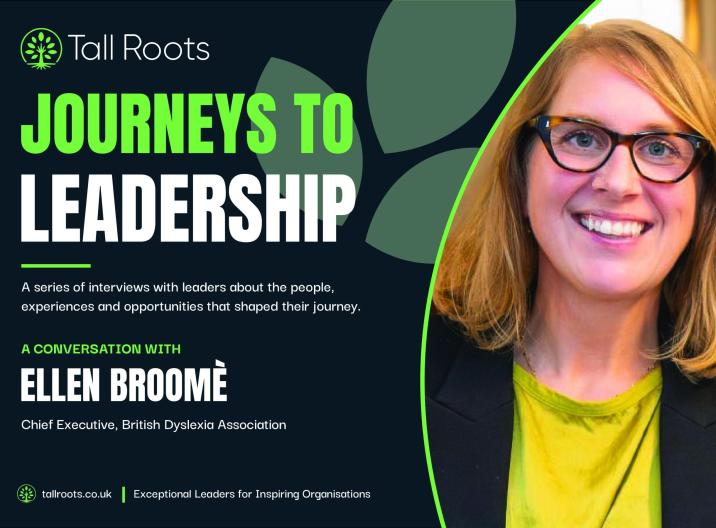
Journeys to Leadership: Ellen Broomé, CEO British Dyslexia Association
Share this article
 LinkedIn
Date posted
21st October 2026
(10-minute read)
Over the past 15 years, Ellen has built a career focused largely on children and young people, with strategic roles spanning service delivery, policy, research, communications and income generation. Before becoming CEO of the British Dyslexia Association, she was Managing Director of two Coram Group organisations. Earlier roles include NatCen, The Children’s Society and the National Autistic Society, and she began her career in Parliament. Ellen has also served as a school governor, is a Trustee of Leukaemia UK and BookTrust, and sits on the National Institute for Health Research’s Social Care funding committee.
We were delighted to speak to Ellen for our Journeys to Leadership series. The series shares honest, encouraging reflections from leaders with different backgrounds: what shaped them, what they learnt along the way, and what advice they would give anyone considering their next career step.
In this conversation, Ellen talks about how a knock to her confidence early in her career gave way to finding her place in the charity sector. She also discusses class, privilege and why recruitment should be better at identifying capability rather than confidence.
---------------------------------------
1. Much of your career has been spent in civil society, focused on issues impacting children and young people. What led you down that path, and at what point did you know you wanted to be a charity CEO?
One of my first proper jobs was as a secondary school teacher. I really liked working with children and young people. They are funny, resilient and full of potential, and there is something very hopeful about working with them. There is so much ahead of them and, with the right support, you can make a real difference to what comes next. I think that stayed with me and probably explains why I’ve been drawn to organisations focused on children and young people.
I then got a job in Parliament, working in politics, where you end up working on everything from planning and immigration to whatever happens to come across your MP’s desk. From there, I made a fairly standard move into a big comms agency, and I hated every minute of it! It just wasn’t a good fit for me.
It really knocked my confidence. I left thinking I was pretty rubbish at everything and wondering whether I’d ever have a career.
Then I got a job at the National Autistic Society as a Public Affairs Officer, and I genuinely think that was the making of me. I loved the team, we had loads of fun and did really exciting work. I had lovely bosses who lifted me up, told me I was good and trusted me. It restored my confidence and made me realise, 'hang on, I can do this'.
I think that’s what happens when you find the right environment and work with a great team. I felt like I’d found my people, my tribe and my place.
I don’t think I ever had a grand plan to become a CEO. My career wasn’t remotely straightforward. I’ve worked in a biscuit factory and done all sorts of jobs in all sorts of places. But I’ve always been interested in taking responsibility. I’ve also worked for some brilliant chief executives and thought, I’d quite like to have a go at what you’re doing!
So I’ve generally just thought, 'I’ll have a go at the next job up from where I am'. And eventually, the next job up was Chief Executive.
2. When you look back, was there one person who particularly influenced the course of your career or inspired you?
I don't think there was one person. I'm from Sweden and neither of my parents is from the UK, so I didn't really have much guidance about how the charity sector worked or how you built a career within it. I tended to reach out to friends and colleagues for advice.
If I'm honest, my partner, who is also a charity leader, was really helpful in shaping some of that. He encouraged me to see that there was nothing wrong with being ambitious, but he also taught me some of the practical things I didn't necessarily know: if you want to apply for a job, then phone the recruiter! Speak to the person who's hiring before you send in the application; build those relationships.
Working for Stephen Byers (then Labour MP for North Tyneside) was also really influential in teaching me how to build networks and strong relationships. And how important that was.
Those things matter. Ultimately, somebody has to give you a job, and being able to draw on a wide network helps. And you should also treat the people you work with well – because one day they might be the person recommending you for your next opportunity or giving you the a job!
3. Have you ever been through a recruitment process where you didn't feel like you belonged, and did that affect how you performed?
Definitely. I've applied for jobs that weren't right for me, sometimes knowing they probably weren't right but trying anyway because I wanted to leave a job that I was in, or just because an opportunity looked good.
But I've also been through processes where I felt that my face simply wasn't quite the right fit.
Sometimes you can tell that you're there to make up the numbers or to make sure the candidate field isn't entirely white men of a certain age. That can be pretty demoralising.
I also recognise that I have a lot of insulation against those feelings: I'm white, middle class and well educated. But even with that protection, those experiences can dent your confidence going into the next process.
And I think that's important because very often what we're actually looking for when we recruit people is confidence. We want somebody who appears assured, self-assured and as though they know exactly what they're doing. If you can't portray that, it can become a problem.
4. Do you think we sometimes mistake confidence for capability when assessing leaders?
Absolutely. 100%.
I think we can be very quick to mistake confidence for capability. I do it sometimes. Someone who is articulate, polished and comfortable in an interview can appear highly capable, but that doesn’t necessarily tell you how good they will be at the job.
Class is part of this. We’re much more conscious now of race, ethnicity, cultural background and gender, but Britain is still a very class-conscious place. There is a particular kind of confidence that can come with being privately educated or Oxbridge educated. That person might be extremely capable, but they may also simply be very comfortable in those environments and very good at presenting themselves.
And it works the other way too. Someone from a different background, or someone with dyslexia, might be equally capable but not perform as well in a conventional interview or exam-style environment. That doesn’t mean they can’t do the job. It means we may be testing their ability to navigate the process rather than their ability to do the job.
That’s why I think we need to be much more thoughtful about recruitment and progression. What are we actually trying to assess? What outcome are we looking for, and what is the best way to test for it? Is it an application form, a conversation, a task, or something else?
Ultimately, we need to make sure we are identifying capability, rather than simply rewarding the people who are most confident or best equipped to navigate the process we’ve created.
5. When we think about who gets to become a CEO, what assumptions about 'executive leadership' do you think we still need to challenge?
One assumption is definitely that CEOs have all the answers. We don't!
I'm a confident person, but I'm not confident in every aspect of my job. I don't come from a finance background, for example, so numbers are harder for me than they might be for somebody who does.
I think you can lead by being honest about that: 'I don't know the answer. Let's work it out together'. Or, 'I'm not very good at this, so I need people around me who are'.
I want people in my team to have autonomy and make decisions. I don't want to be the ultimate arbiter of everything – that isn't going to create a well-functioning organisation.
CEOs also get things wrong. I certainly do. When that happens, you have to be able to say, 'I'm really sorry, I got that wrong'. How do we fix it?
Another assumption is probably that being a CEO is more glamorous than it really is! I probably contribute to that because I’ll put something on LinkedIn when I’m doing something interesting. But nobody is filming me sitting at my kitchen table at 10pm wrestling with a spreadsheet, chasing a late delivery, sorting out a broken printer or trying to work out why the heating in the office has stopped working or how we fix it.
There’s a lot of very ordinary, practical problem-solving that comes with running an organisation. Some days you’re talking to ministers and meeting senior leaders, and the next you’re dealing with a broken photocopier. There's quite a lot less glamour involved than people might imagine.
6. If you could change one thing about how senior leaders are recruited, what would it be?
I'm not sure our traditional recruitment processes are really fit for purpose. I think they often test the wrong things.
You'd probably get a better sense of who I am and whether I'm right for your organisation by having a genuine conversation with me rather than putting me through a very traditional interview.
Usually, you're not trying to test whether somebody can memorise huge amounts of information. You want to understand how they think, how they'd approach a problem and how they'd work with other people.
For a CEO appointment, for example, are they going to work well with the Chair? If you're recruiting someone into a senior leadership team, how will their working style fit alongside the people already there?
You can ask someone to describe their leadership style in an interview, but I think it would be much better to find ways of actually seeing some of that in practice.
I don't know whether one approach would work for every job, and doing this properly requires time and thought. But I'd like recruitment to feel less like an interview and more like a genuine dialogue: Are we going to be a good match? What would it actually be like for us to work together?
7. Finally, what advice would you give someone who doesn't see people like themselves represented in leadership?
Reach out to people.
I've found my fellow charity chief executives to be an enormous source of strength, support, kindness, advice and information.
If you emailed three people and said, I'm thinking about taking this next step and I'd really like to hear about how you approached your career, I think the overwhelming majority would happily make time for a coffee or a conversation.
But you have to ask. They aren't going to know that you need that support.
There probably aren't enough opportunities for those relationships to develop organically, particularly if you don't already have the networks, so sometimes you have to be proactive.
You can also learn from lots of different people. You might look at one person's approach and think, that isn't me at all, but take one useful thing from it. Then you meet somebody else and think, I can see myself doing it that way.
And there is another benefit. If somebody gets to know you and thinks you're brilliant, the next time a recruiter asks them, 'do you know anyone we should be speaking to?', they might think of you.
Trust people's generosity and ask for their advice. In the ten years since I first became a Chief Executive, I've very rarely had somebody refuse when I've asked for help.
Somebody might think you're a bit forward. If that's the worst thing they think about you, good for you!
--------------------------------------------------
Journeys to Leadership is a series of short interviews with leaders to understand the people, experiences and opportunities that shaped who they are today.
By sharing different leadership journeys from a range of CEOs, Director and consultants, we hope to inspire those who may not yet see themselves as leaders, or who may have hit barriers in their own journey to leadership, while also helping organisations to think differently about leadership potential.
Share this article
 LinkedIn