
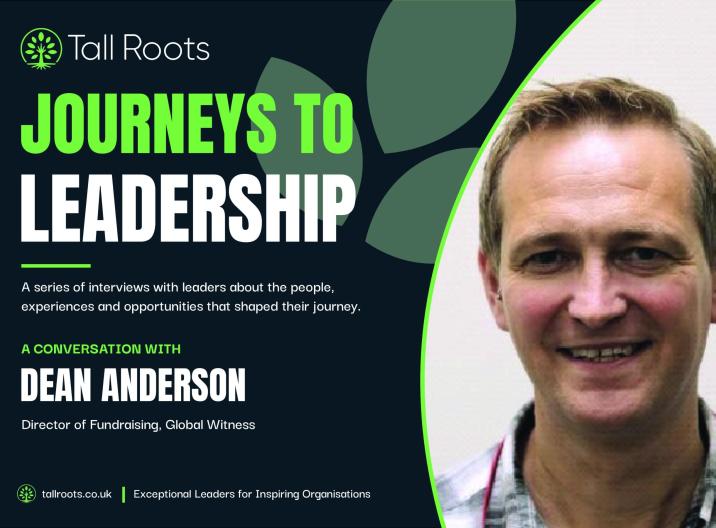
Journeys to Leadership: Dean Anderson, Director of Fundraising, Global Witness
Share this article
 LinkedIn
Date posted
20th November 2026
Dean Anderson’s career spans almost three decades in fundraising across the charity and international development sectors, working with organisations including Amnesty International, ActionAid, War Child and the Mines Advisory Group. Having progressed from trust fundraising into senior leadership, his journey has been shaped by a belief in the value of different leadership styles and the importance of recognising potential beyond conventional career paths.
We were delighted to speak to Dean as part of our Journeys to Leadership series. In our conversation, Dean reflects on finding his place in fundraising as a naturally shy and introverted person, the people who recognised potential in him before he saw it himself, and how imposter syndrome has influenced his career. He also shares his perspective on class and privilege in the charity sector, why traditional recruitment processes can overlook talented leaders, and the qualities that quieter, more understated leaders bring to organisations.
---------------------------------------
1. What led you into a career in fundraising? Was there anything about the role that initially made you doubt whether it was the career for you?
I never planned fundraising as a career. I certainly never thought of it as one – I didn't really know those jobs existed growing up. It wasn't as big a sector as it is now and people didn't talk about that kind of thing.
What I did know was that I wasn't someone who could work in the business world. Being from my area of Essex, lots of people went into finance and that sort of thing. The idea of wearing a suit every day and doing that absolutely horrified me, although I didn't really know what the alternative was.
I explored more creative things. I thought I could be a teacher, and I also really wanted to be a writer. When I was about 13 or 14, I wanted to be a sports journalist. I used to go and watch Southend play and, really geekily, would send reports of the matches into the local paper. They never published them, but they often wrote back and were very encouraging. They did accuse me of bias at one point, which was fair enough!
The only job I had before getting into the sector was briefly as a junior civil servant at the then Department of the Environment. Through fate really, I ended up administering a grants programme for environmental projects in Eastern Europe, not long after the fall of communism. I found that fascinating. I'd also become more politically aware, was involved in some protest groups through music and had become a little involved with Amnesty.
My first charity job was at the National Playing Fields Association. It was a small organisation, and I was a kind of all-purpose fundraiser. I wasn't there long, but it gave me a good grounding. Once you're in the sector, you start hearing about different organisations and roles, and I knew I wanted to work in international development. I also realised I could use the creative writing skills I'd always enjoyed to good effect.
But I definitely wondered whether fundraising was for me. Particularly at that age, I was very, very shy and struggled to speak to people. Suddenly I was in a job where someone would say, ‘Go and talk at a school’, or I'd have to do something on the radio. I didn't enjoy that. I remember thinking, ‘I don't think I can do this job’.
It was when I became a trust fundraiser at ChildHope that I found my niche. It was serious bid writing: I could sit in the corner and construct these things and work one-to-one with programme teams. That was when I thought, ‘Right, I can do this. I want to do this’.
2. When you look back, is there one opportunity or moment that changed the course of your career?
There have definitely been a few sliding-doors moments. I'm still really good friends with the person who gave me that job at ChildHope – he's retired now, lives near me and we still meet up for a Friday beer and lunch. I’m very grateful to him for kick starting everything.
But if I had to pick one, it would be getting the job at Amnesty.
It was somewhere I really, really wanted to work. Immediately, there was a sense that this was serious stuff. It's an institution, a national treasure, a Nobel Peace Prize winner. You felt like you were representing something so much bigger than yourself.
I was there for eight years and was promoted twice. I probably learnt just about everything I know about leadership and fundraising there. It was incredibly formative.
It wasn't just the fundraising either. Amnesty isn't a traditional hierarchical organisation; people have views and opinions. So I learnt a huge amount about management, leadership and organisational culture.
When I moved into more senior management there, I had strong opinions about how some things were being done and suddenly had the opportunity to change them. I worked with some brilliant people and we talked a lot about collaboration and what we wanted to achieve. Everything just flew.
I eventually led the team and was briefly Interim Director of Fundraising. Those eight years coincided with my children being born and being very young, and it just feels like that period shaped everything.
I look back on it with immense fondness and pride.
3. Have you ever benefited from someone seeing potential in you that you perhaps didn't yet see in yourself?
Absolutely. Helen McEachern (then Director of Fundraising at ActionAid UK, now CEO of CARE International UK) is the first person who comes to mind.
I hadn't really mapped out a career path or decided I wanted to become a leader. It's been more a case of doing a good job, trying your best, and then an opportunity comes up. Every time, I've had that conversation with myself: ‘Do I actually want to do this?’.
And I've usually thought, ‘Well, I do have opinions about how I would do it’. If I don't go for it and someone else gets it, that's fine. But I'd rather throw my hat in the ring, tell them what I think and, if they want it, great.
Helen gave me the opportunity to lead the Philanthropy & Partnerships team at ActionAid, where I stayed for another six years. If Amnesty was formative for me, ActionAid really helped me grow as a leader and as a person. The work they were doing around anti-racism and feminist leadership was incredible.
I'd left Amnesty a couple of years earlier and really wanted to get back into that kind of environment. I wanted the ActionAid job very badly – and I completely messed up my first interview.
Helen called me back for the second round anyway. We met for coffee beforehand and she told me that I was the right type of leader for ActionAid UK. I just didn't see it at all.
I had – and still have – a lot of imposter syndrome. I was nervous about being front and centre and it was a big team. But Helen had total faith in me.
I remember going into my probation review genuinely thinking I'd messed up and was going to be out. Instead, she basically said: ‘You're brilliant, you're doing so well – what is the matter with you?’.
She valued my leadership style, as did the organisation. She described it as understated leadership. But it was determined, it was ambitious, the money was coming in and collectively we did an amazing job.
We're friends now and I quite often end up telling her that she changed my life in quite a big way. I genuinely don't know what would have happened if she hadn't called me back and given me that opportunity.
4. Who do you think is still being overlooked for executive roles in the charity sector, and why?
There are probably better people than me to talk about some aspects of this. I recognise who I am: I'm an older white man who has privileges in this regard.
I've worked in organisations that have had serious conversations about feminist leadership, anti-racism and who have learnt from movements such as Charity So White. I know the privileges I have, and I know that women and people of colour remain underrepresented at executive and CEO level. The why exists for many historical and cultural reasons that are far too complex to get into here, but absolutely should be part of organisational conversations.
At the same time, I've personally experienced class bias. I've been told, ‘You don't seem like the sort of person who comes from Essex’. There can be assumptions that if you're a major donor fundraiser going to an event, you somehow have a wardrobe full of tuxedos. I've also found the academic discourse in some organisations I've worked in quite intimidating.
Culture can be an incredibly powerful driver, but it can also become something that excludes people from the conversation. Even in organisations where I've seen really good cultural practice, there have been moments when I've stepped away from a discussion because I've thought, ‘I'm the least qualified person in the room to talk about this’.
I also think the way charities are governed doesn't necessarily help. A certain type of person can become a board member because they have the time and circumstances that allow them to do it. That doesn't always lend itself to radical intervention or to creating boards containing the people who might challenge existing structures.
And that flows into recruitment. We interview in a certain way and look for certain things.
You can make a conscious effort to introduce inclusive policies, live and breathe them, and be aware of your own privilege – and still get to interview stage and be sucked in by the person who is the most excitable or impressive in the room on the day.
I think all of that could do with a massive shake-up if we genuinely want greater openness and diversity.
5. Are we good enough at recognising potential in people whose careers haven't followed a traditional path?
I'd say no – although I also recognise that it has happened for me.
I've been told by more than one person that it's unusual for someone with my background in trust fundraising to become a Director of Fundraising. That's probably true. Trust fundraising tends to play to things like introversion and writing skills, which aren't necessarily the characteristics traditionally associated with leadership.
There are certain paths that are still seen as more suited to leadership than others. We have a lot more to do to recognise authentic leadership and understand that it comes in many different varieties and from many different places.
There are definitely ways of ‘playing the game’ that we're all attuned to, and I think it's very difficult to remove ourselves completely from that.
As an introvert, I try to recognise fellow introverts. If you're culturally strong, have views and opinions and want to put those forward, that's what matters. But there is still a certain way of playing the game that will get you further than others, and that's unfortunate.
There are practical things we can do. Sharing interview questions in advance is a really good example. So is being explicit that somebody doesn't need to meet every single criterion: You don't have to be perfect. This is a sketch of what we want the role to be. Go for it. Come and tell us who you are and what you bring.
The language you use in adverts matters too. Who are you encouraging? What does your organisation look like from the outside to somebody from an underrepresented background? Who is doing the recruiting? What perspectives have been brought into the process?
All of those things play into it.
I think we're changing, but we're changing very slowly.
6. Finally, what's one thing you wish more aspiring leaders believed about themselves?
I've come to think that imposter syndrome is a strength that decent people possess.
It's taken me a very long time to get anywhere close to believing that – and I'm not even sure I'm completely there yet.
The people around you who you admire and think are brilliant will have their doubts and their demons too. I've learnt so much about leadership over the last decade, and my reflection is that quietness, reflectiveness, calmness, shyness, introversion and low ego can be amazing qualities for an organisation.
I grew up in an era when those things wouldn't have been called leadership. You had to be the person at the front of the room. You had to own everything, know everything and be loud.
That's changing.
There are still things that make me uncomfortable. My first instinct when I was asked to do this interview was absolutely not! I'm pushing myself slightly by doing it. I still don't want to stand on a stage in front of a load of people. I will, and I have done, but I still don't really want to.
And that's fine.
Own it. Admit it. Know your strengths. Know when somebody is better than you at something and open those doors.
If you want to lead, if you have thoughts and ideas about how something should be done, and there's an opportunity in front of you that you think you can do – go for it. You need to be accountable for that, but bring your own style and be authentic.
That's something I now take into interviews. If who I am and how I lead is what the organisation wants, they'll see it. I'll be a good fit, and I'll be able to bring those things to bear.
If it isn't what they want, that's not necessarily on me. It's a lack of alignment. It might be a job I really want, but ultimately it would probably be a bad job for me.
You have this wealth of experience and knowledge. You have your style. You know what you're doing.
They want it or they don't. Or perhaps they just slightly prefer somebody else.
That's it.
Thinking about interviews in that way has always helped calm my nerves. I'm just going to go in there, tell them who I am and what I've got, and so be it.
---------------------------------------
Journeys to Leadership is a series of short interviews with leaders to understand the people, experiences and opportunities that shaped who they are today.
By sharing different leadership journeys from a range of CEOs, Director and consultants, we hope to inspire those who may not yet see themselves as leaders, or who may have hit barriers in their own journey to leadership, while also helping organisations to think differently about leadership potential.
Share this article
 LinkedIn
More Insights
-
 Insights
Journeys to Leadership: Simon Blake OBE, CEO of Stonewall
- Read more
-
Date posted
5th November 2026
-
 Insights
Journeys to Leadership: Marcia Bluck, Director of People, Culture & Governance at Turn2us
- Read more
-
Date posted
30th October 2026
-
 Insights
Journeys to Leadership: Ellen Broomé, CEO British Dyslexia Association
- Read more
-
Date posted
21st October 2026