
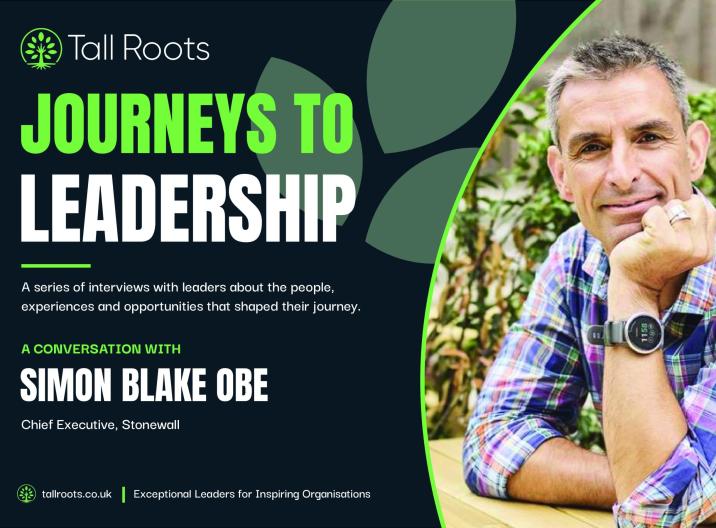
Journeys to Leadership: Simon Blake OBE, Stonewall
Share this article
 LinkedIn
Date posted
5th November 2026
Simon Blake has spent his career working to create change across the charity, health and social justice sectors. From leading organisations including young people’s charity Brook, the National Union of Students and Mental Health First Aid England to his longstanding involvement in the ongoing campaign for LGBTQ+ equality, his career has been shaped by a belief in doing what is right, even when it is difficult.
We were delighted to speak to Simon as part of our Journeys to Leadership series. In our conversation, Simon reflects on growing up as a gay man in Cornwall in the 1980s, finding his way into leadership almost by accident, and the courage it takes to stand by your values. He shares what he has learnt about leading with humanity, preparing the next generation of charity leaders and why traditional recruitment processes can overlook leadership potential. Above all, Simon offers a thoughtful reminder that leadership doesn't have to follow a conventional path – and that not seeing someone like you in a leadership role doesn't mean you can't be the first.
--------------------------------------------
1. You've previously spoken about growing up gay in Cornwall in the 1980s as lonely, and learning that gay people were, at best, 'not good enough'. You were also the first in your family to go to university. How did you go from those early experiences to seeing leadership as something that could be for you – and was there a particular point when that changed?
Probably the most important thing to say is that my whole career has been accidental. There was never a moment where I took a long view and thought, 'I'm going to do this' or 'I'm going to do that'.
I was originally going to train to be a clinical psychologist but instead ended up having a series of jobs in the voluntary and community sector, which I enjoyed immensely. I always thought I would go back to Uni and finish my training as a clinical psychologist. I even thought about it when I was 40.
So, leadership was never a decision as such. And that is worth being really explicit about, because sometimes it feels like people want a job because of the job title. I have tended to take a role because I have wanted to change something, do something or make something happen – or because somebody thought I'd be good at making that happen.
My first real leadership role was at the Sex Education Forum. The Forum tried to bring together different groups with different perspectives to create a consensus. Gill Frances, who was the Director at the time and who appointed me, saw potential in me and felt I was good at recognising that it's possible for there to be a multiplicity of views.
So, I was afforded leadership opportunities, and the more opportunities I had the more I thought "Oh, I can do this"
Now, I will contradict myself quite quickly by saying that I still often think, "Can I do it?"
I've been a chief executive of various organisations for about 20 years. Some days I've felt I have done a really good job and will be able to navigate any given situation. Other days, I’ve doubted myself.
Leadership is also more public now because there are more platforms for people to tell you what they think. I've often had people say, ‘well that’s just accountability’. Shouting at me via Twitter is not accountability; it is someone believing they have a right to shout at me via Twitter. That's very different from me being accountable to them .
We often talk about silence as being complicit. Sometimes, saying nothing can be the most important thing you can do in order to break through the noise.
2. One of Stonewall's values is courage, and I know that's something that means a lot to you personally. Where does your own courage come from as a leader – and what have you learned about sustaining it over a 30-year career?
It links to what I said before. I have always gone into roles believing what needs to happen. I know that there are lots of different ways to create change as long as you know what the outcome needs to be.
Therefore, it doesn't always feel like courage; it feels like doing the right thing. When you translate ‘doing the right thing’ into a value, it becomes courage.
Life is tricky sometimes. Conversations can be tricky because we all respond differently.
One of the most seminal moments in my career was when I was on a NHS leadership programme. We had a nurse who said to us, "You're all bureaucrats. Whether you're in the voluntary sector or the NHS, you will probably never have to go and tell someone that they're dying, their partner has died, their partner is going to die, or their mother or father is dying. I have nurses who do that every single day.
"So next time you have to tell someone that their report is too long, that they're five minutes late, or that they need to put some deodorant on, just think about that in comparison with what my nurses are doing every single day."
That was over 20 years ago now, but if I'm preparing for a conversation I don't want to have, I still have that in my head.
And I have also personally experienced nurses do that twice now. Once with my parents when my brother was dying and once when my mum received a terminal diagnosis. Clinicians that communicate with compassion really are the best of us.
Seeing how they can do such difficult things in such thoughtful ways, with such compassion, gives you courage.
Standing up and saying something through a difficult process is important when you are doing the sort of work we are. If you're not willing to do that, you should find something else.
3. You've now spent a significant part of your career in CEO roles. What's something about leadership that you understand now that you couldn't possibly have understood when you first became a CEO?
We have to do everything in a very, very human way. And what that normally means is thinking in advance: when I'm saying this, what are people likely to hear?
Take a redundancy programme. We must think very carefully about the language. If we say, "We are proposing to delete the post because...", what the person hears is, "Will I be able to pay my rent or my mortgage?"
By walking in their shoes, we can better understand what they are hearing and use language that reflects that, rather than trying to remain very po-faced.
Also to remember that we don't take our slippers off, put our shoes on, go to work and then put our slippers back on again when we get home. We take all of ourselves into the work space.
We need to look after ourselves: do things that make you happy inside and outside work. Work should always be fulfilling. Every day is not going to be a party, but we have to have the energy and passion for what we are doing – and know when it is time to leave.
Appoint people who are better than you and who share the same core values. Disagreement is an essential part of reaching the right decisions.
We use words like ‘conflict’ in ways that stop people from having and expressing different views. We need to create space where people don't only put their hand up when they've got the right answer, but can ask a question that provokes thinking, creativity and new ways of looking at things.
People are always watching you. They will be listening to both what you do say and what you don't. You have to take responsibility for that.
Allow people to know who you really are. We have to be in relationship with people in order to work well and effectively as part of a team.
And finally, we are human. We will inevitably make mistakes. We won't always take everyone along with us.
4. I know you have a real belief in the next generation of civil society leaders. But as charity leadership becomes more complex and demanding, are we doing enough to prepare emerging leaders for that transition – and to support them once they get there?
The Chartered Management Institute says most of us are ‘accidental managers’. Almost everybody I know – including me – is one. .
So, the short answer is probably not.
If we can prepare people for the joy and responsibility of leadership, they will always be able to find ways to navigate through the difficult things and learn from our collective mistakes.
People have always been incredibly generous to me, and I always try to be generous back. If somebody asks for some time, of course you'd always give them some of your time.
But you also don't want to prevent people from making mistakes or from doing it their way.
If you are a good manager, there are some basics: make sure people know what they've got to do, what success looks like, how they do it, that they feel responsible for it and that they've got the tools to do it. But within that, there are so many different ways of doing things.
In all my roles I have tried to enable people to understand themselves and each other so they can understand and value difference. We have recently done personality profiles at Stonewall. Initially we're all saying things like, ‘I'm blue, I haven't got enough green’ or ‘I'm red, I haven't got enough yellow’. But actually, if you understand yourself and have a language to talk about who you are and how you work – without using it to excuse bad behaviour – it helps us interact with each other. Relationships, partnerships and teams all work better when people have that self-awareness.
Dilys Cossey (campaigner and former Chair of the young people’s charity Brook), once made a point that has always stayed with me. We often get obsessed with whether something is more or less difficult at any particular point in time.
She was talking about sexual and reproductive health challenges across generations – from no contraception and backstreet abortions, through to the impact of pornography on young people. Those things are all difficult to navigate, but they're all very different. It isn’t helpful to say one was harder than another. Hard is just hard, and when you are living something, you understand what you're living. That's the nature of it.
Navigating life as a leader with a digital profile is likely to be easier for digital natives than for somebody like me who didn't have a mobile phone until they were 26.
People have always had views about leaders and their decisions. What has changed is people express that view more readily now. But lots of people in their early careers will already be used to environments where things are judged online, so they might be better able to navigate that than somebody older who's had to learn to deal with it.
Intergenerational stuff is always fascinating. We should be doing as much as we possibly can to share knowledge – and then allow people to use it how they best see fit.
5. You've been through plenty of senior recruitment processes yourself and also recruited many leaders over your career. What do you think our traditional approaches to senior recruitment are good at identifying – and what kinds of leadership potential do you think they can miss?
When I look at traditional recruitment processes – which I've obviously been part of and used myself – they're a little bit like school. They essentially focus on knowledge.
Interviews should be relational and two-way. That way we would get a much better sense of what a new person will add to a team and how. The risk, of course, is making sure that we don’t simply appoint people who are like us.
I am sure we could be far more creative about testing for brilliant problem-solving and decision-making.
What I actually want to understand in an interview is the thought process. How would you get from A to B in your thinking? Not simply: would you go to B or would you go to C?
6. Finally, what would you say to someone whose background or experiences have made them question whether leadership is really 'for them'?
Leadership is for everyone, as long as you know why you want to lead.
I was at a Terrence Higgins Trust event recently and Nicola Adams, the boxer, said that normally people say, "You can't be what you can't see". She turned it on its head and said, "I couldn't see it, but I knew I wanted to be it. And I'm now a world champion".
I loved that. There always has to be a first.
I remember when I was in the student movement, somebody who had dyed their hair a particular colour said, "There isn't anybody else like me in the movement." I said, "There will be somewhere. We just haven't seen them in this moment".
We are all leaders in our own way. And I don't mean that in a glib, ‘Oh, everyone's a leader’ way. But everybody is a leader in some way, shape or form.
You're the chief executive of your own job. You may be in a system, and you may be in a structure, but you are actually leading – whether that's a parliamentary process, an organisation or whatever it is.
But these leadership positions are not for everyone! Many roles in the social sector are not for the faint hearted.
Not everybody has to be a leader, not everybody wants to be a leader, and not everybody should think leadership is the only way.
When we are talking about director-level leadership, I often think I'm only a good chief executive when I have a good number two. When it comes to trustee roles, I'm often sought out to be a deputy because I'm good at getting things done.
There's quite an interesting dynamic there. In the day job, I ended up being a chief executive probably sooner than I thought I might, and certainly more times than I expected.
I wasn't going to go for another job after Mental Health First Aid England. I only did so because I decided I wanted to do this job and work on this issue, rather than because I wanted to be a chief executive again.
So just because you can't see somebody like you, it doesn't mean you can't be a leader.
And just because you can see people like you, it doesn't mean you have to be one.
-----------------------------
Journeys to Leadership is a series of short interviews with leaders to understand the people, experiences and opportunities that shaped who they are today.
By sharing different leadership journeys from a range of CEOs, Director and consultants, we hope to inspire those who may not yet see themselves as leaders, or who may have hit barriers in their own journey to leadership, while also helping organisations to think differently about leadership potential.
Share this article
 LinkedIn
More Insights
-
 Insights
Journeys to Leadership: Marcia Bluck, Director of People, Culture & Governance at Turn2us
- Read more
-
Date posted
30th October 2026
-
 Insights
Journeys to Leadership: Ellen Broomé, CEO British Dyslexia Association
- Read more
-
Date posted
21st October 2026
-
 Insights
Journeys to Leadership: Naomi Hulston MBE, CEO of Catch22
- Read more
-
Date posted
15th October 2026