
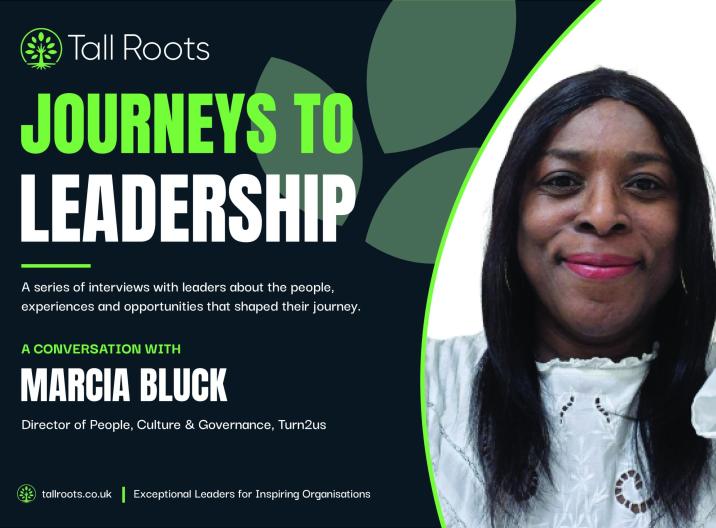
Journeys to Leadership: Marcia Bluck, Director of People, Culture & Governance at Turn2us
Share this article
 LinkedIn
Date posted
30th October 2026
Marcia Bluck is Director of People, Culture & Governance at Turn2us. Over the past 20 years, she has built a career across the public, private and voluntary sectors, including serving as Interim CEO and holding senior leadership roles at Mind and The Trussell Trust. Her work spans organisational transformation, culture change and board advisory roles, including working with senior political figures and institutions such as the Home Office, NHS, local government and the Metropolitan Police. She is also a keynote speaker committed to advancing anti-racism, equity and people-centred change.
Marcia has spent much of her career speaking truth to power and challenging institutions to become more inclusive. But has using her voice always come naturally?
For our Journeys to Leadership series, Marcia reflects on growing up in Wolverhampton as a child of the Windrush generation, the example set by her parents, and how her Christian faith shapes her approach to leadership. We also explore the emotional labour of repeatedly having to establish her credibility as a Black woman, and what organisations need to do to attract, support and retain more diverse senior teams.
---------------------------------------
1. I’d love to start by finding out a little more about you. You grew up in Wolverhampton as a child of the Windrush generation. What was your childhood like, and what did you learn from your parents that has stayed with you as you’ve become a leader?
I’m the youngest of seven. I often joke that my parents kept going until they got it right!
There was a real sense from my parents that we needed to make the most of the opportunities we had. That work ethic was always there. But what I remember most is the sense of community and collective responsibility.
Whether it was the creation of Black-led churches because people weren’t always welcome elsewhere, or people pooling their money through Pardner because the banks discriminated against them, the message was: if we’re going to thrive here, we need to look after each other.
I don’t think my parents would have described it as collective action, but that’s what it was. Everybody in the community was everybody’s responsibility. It also meant you couldn’t misbehave, because somebody always knew somebody!
There was resilience too. My parents both experienced racism and discrimination – my dad was overlooked for opportunities at work as an engineer, and my mum would go into a shop with money that she’d worked hard to earn, but the shopkeeper would ignore her and serve other people.
She would just stand there until she was served though. She stood up for what was right, but with such grace and dignity. I think that’s an important leadership skill: having the moral compass and courage to challenge something, while still being able to bring people with you whilst not compromising who you are.
Our home was also somewhere people came when they needed help. Someone might come to us because they were having difficulties with an abusive partner or they ran out of money for the gas meter. We weren’t wealthy, but my mum always shared what she had.
Reflecting on it now, I realise she was a leader without the title. People knew who to go to.
She also had strong boundaries, but made people feel safe enough to tell her things. She would say: “I might not approve of what you’re telling me, and I might even have a go about it, but I’ll be more upset that you didn’t feel you could come and tell me.”
That’s something I’ve carried into my own parenting. You can have boundaries and still make it safe for people to be honest with you.
2. Your Christian faith is an important part of who you are. How has it shaped the way you think about your own purpose and leadership?
I made a personal decision to become a Christian when I was 11. For me, a central part of that faith is the belief that every person has inherent dignity and worth, however imperfect they might be. And we can all join that queue!
I try to bring that into my leadership. Even when someone isn’t behaving as I would like, I have to stop and remember that they’re a person coming into work with all sorts of things happening in their life. We mustn’t lose sight of their humanity. And I will always try to make time for people.
My faith also shapes how I think about power and responsibility. If you have something available to you, whether that’s financial resources, education or influence, how are you using it to benefit the wider world? Power isn’t there to put yourself above somebody else.
And forgiveness is a big part of it. When I’m feeling offended or thinking someone shouldn’t have treated me in a particular way, my faith brings me back to giving the same grace that has been shown to me.
That’s what I try to do, anyway... you might need to ask the people who report to me how well I manage it!
3. You’ve spent much of your career challenging institutions to become fairer and more inclusive, often speaking truth to people with more positional power. Were you always comfortable using your voice in that way, and what have you learned about doing it effectively?
My mum was never shocked by anything I said I wanted to do. If I’d said I wanted to be Prime Minister, her response would have been: “Well, what are we going to do to get you there?” She gave me a deep sense of self-worth and a belief that my voice mattered.
That doesn’t mean using it was always easy. You will still encounter people who aren’t comfortable with you speaking up. It makes you pause and analyse everything in your head before speaking aloud.
In the earlier days, I probably tried to be too perfect. I thought I had to know everything and get everything right before I spoke. But I kept coming back to that sense of responsibility: if I don’t say something, then who will?
Over time, I’ve become clearer about my non-negotiables. If we both want to learn and move forward, that’s great. But if someone doesn’t want to engage, I’m less concerned now with trying endlessly to convince them.
I’ve also learned to understand my audience. I used to think there was only one way to say something, and people needed to be comfortable with that. With experience, you understand that people come to a conversation with different fears, experiences and concerns about their status.
Your truth doesn’t change, but your delivery does.
4. As a Black woman who has spent much of her career advising boards and senior leaders, have you ever felt you needed to work harder to establish your credibility or authority, or adapt your style to fit in? Has that changed as you’ve become more senior?
Of course. There’s a split second when I enter a room where I scan who’s there, work out where I think I sit and assess whether this will be an easy space or one where I will need a steel spine.
It happens so quickly that it’s difficult to articulate, but I still do it. How much I worry about it nowadays might have changed, but the assessment is still there.
Earlier in my career, I was working twice as hard, even if I didn’t always consciously recognise it. You become aware that being credible isn’t necessarily enough to get you through the door. I still feel at times that I am not afforded the grace to make as many mistakes as others. Again, I have learnt to retrain my thoughts so that it doesn’t hold onto any negative beliefs for long.
There have been times when I’ve adapted my style. I also find myself deliberately challenging people’s assumptions about who I am and what my life looks like. That takes emotional labour, and some days it’s exhausting.
And this doesn’t happen separately from everyday life. I experienced a racially motivated attack earlier this year. It wasn’t that I was naïve about racism, but I was doing something as ordinary as dropping my daughter at a youth group.
I remember thinking: I don’t have the energy to go back to that level of second-guessing where I am and how safe I feel. All of that forms part of the experience you carry into other spaces.
5. You’ve spent more than 20 years working in People and organisational development, so you’ve recruited a lot of people. But you’ve also experienced senior recruitment from the other side of the table. Has being a candidate changed how you think we should assess people?
I’ve experienced processes where you go through six rounds and the organisation still says it isn’t sure. If you don’t know after six rounds, something is wrong!
We need clearer expectations. Recruitment shouldn’t become a process where the employer is still working out what it wants while candidates keep giving their time. You can often tell when an organisation hasn’t prepared properly. Not publishing the salary is a big red flag.
One thing I valued in my experience with Tall Roots was the balance between exploring competence and understanding me as a person. Questions about who had motivated me brought out more emotion than I expected, but they also gave me the chance to show who I was and what mattered to me.
That’s something I’ve tried to carry into my own recruitment. Some of the biggest difficulties I’ve experienced with employees haven’t been about their technical performance. They’ve been about behaviours and a lack of alignment in values.
I think the days of treating interviews as tests or exams to pass need to go. We should create the conditions for people to show up at their best. I’ve seen people struggle through an interview, then spoken to them afterwards and thought: why didn’t you say that in the room?
The experience before the interview matters too. How comfortable do I feel speaking to the person arranging it? If there’s a problem with availability, are they willing to work with me? How open and approachable are they?
I’ve ruled out opportunities because of that experience, even after being offered an interview. We can become so focused on questions and getting people through a process that we overlook what our behaviour is telling them.
6. Organisations consistently talk about wanting greater diversity in their most senior roles, but many still struggle to achieve it. Where do you think organisations favour people who fit an existing idea of a senior leader, and what should we do differently?
We need to be brave enough to disrupt what we’re doing. Sometimes, particularly in charities, we spend so much time explaining or apologising for where we are that we don’t simply acknowledge the problem and change it.
We also need to think about what happens after someone joins. Have we prepared the executive team? Has the chief executive thought about the experience that person might have? We don’t always do enough work to help people stay.
Then there’s where we look for talent. When people say they can’t find diverse candidates in areas such as communications and marketing, I think: you’re not looking in the places I am.
If your own circle doesn’t reach those people, who could you partner with? And do that respectfully. Don’t expect somebody to provide free labour to solve it for you.
The charity sector can also fall into the trap of thinking that we’re good people, so we can’t possibly be biased. That can make people less open to examining their own decisions and discomfort.
People often feel comfortable with people who are like them. Challenging that takes deliberate effort, particularly under pressure, when it can feel easier to choose what you think is tried and tested.
There’s another issue we need to recognise. I’m seeing more Black professionals decide they would rather work for themselves. They’ve spent years in organisations and have reached the point where being in control of their own working life feels safer.
So even when the candidates are there, do they want to come back? What can you tell them about how they will be supported and protected? We can’t keep saying we’re on a journey without addressing what people already know about working in organisations.
7. Finally, if you could speak to an earlier version of yourself, before the senior titles and boardrooms, what would you tell her about using her voice and knowing she belongs in those rooms?
You do not need to wait for permission to use your voice.
Think about dignity, respect and how what you say will land, but otherwise just go for it. Don’t let perfection become the enemy of just good enough. That’s something I still have to remind myself of.
Confidence grows through action. I spent time looking at people in certain spaces and thinking I had to do all these things before I could be like them. Sometimes they’d simply had an opportunity I hadn’t, such as sitting in a board meeting and learning how a committee worked.
Have a go. That’s how you build confidence.
And don’t second-guess yourself so much. Other people in the room are probably doing it too, and some aren’t thinking about you nearly as much as you imagine.
If I have a regret, it’s probably that I didn’t show the courage I felt inside a little earlier. I was waiting for everything to be in place, or feeling that certain opportunities were somehow for somebody else.
I’d tell a younger Marcia: just go for it.
--------------------------------------------------
Journeys to Leadership is a series of short interviews with leaders to understand the people, experiences and opportunities that shaped who they are today.
By sharing different leadership journeys from a range of CEOs, Director and consultants, we hope to inspire those who may not yet see themselves as leaders, or who may have hit barriers in their own journey to leadership, while also helping organisations to think differently about leadership potential.
Share this article
 LinkedIn
More Insights
-
 Insights
Journeys to Leadership: Ellen Broomé, CEO British Dyslexia Association
- Read more
-
Date posted
21st October 2026
-
 Insights
Journeys to Leadership: Naomi Hulston MBE, CEO of Catch22
- Read more
-
Date posted
15th October 2026
-
 Insights
Let's talk about AI, authenticity and the privilege of writing well
- Read more
-
Date posted
20th May 2026