
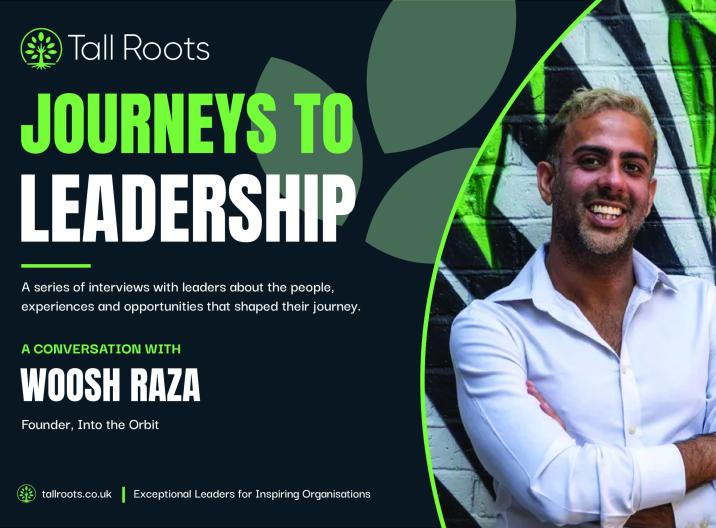
Journeys to Leadership: Woosh Raza, Founder of Into the Orbit Consulting
Share this article
 LinkedIn
Date posted
26th November 2026
Woosh Raza’s career has taken him from banking and healthcare into senior HR leadership, where he has spent more than 15 years working across culture, inclusion and organisational change. Now Founder and Principal Consultant of Into the Orbit, Woosh brings both professional expertise and lived experience to his work, helping organisations create environments where people can thrive and feel safe.
We were delighted to speak to Woosh as part of our Journeys to Leadership series. In our conversation, he reflects on navigating identity and belonging, finding his way into HR and the experiences that have shaped his commitment to inclusion. He shares why organisations need to look beyond representation and address the cultures and systems that hold people back, what needs to change in executive recruitment, and why empathy, boundaries and community matter in leadership.
---------------------------------------
1. You’ve spoken previously about having ADHD and navigating the queer scene as a young Muslim man in Manchester. To those who meet you today, you seem a natural leader with a lot of confidence. Was that always the case, and what helped you find that confidence?
Confidence is an interesting word. I was unpacking it with a good friend recently: does it mean having high self-esteem, being sure of who you are, or knowing what you’re putting out into the world?
That hasn’t always been easy for me. It still isn’t. It can be nerve-racking to exist in the spaces I do, as the person I am.
But I grew up in a loud, chaotic, bubbly household where people were unapologetically themselves. Mum would say the first thing that came into her head, and Dad would be Dad. There was a culture of authenticity, so in some ways I didn’t feel I had much choice but to be me.
I don’t think any of us reaches a point where we’re completely confident in who we are or what we’re doing. That fragility and insecurity are part of being human. It certainly isn’t a linear journey. There have been lots of different versions of Woosh, and I’m sure there will be plenty more!
For me, confidence is about whether I feel aligned with my values in that moment. That’s where I feel more assured.
I’ve often described my experience as feeling “too queer to be brown and too brown to be queer”. We’re never just one thing, and finding a sense of belonging across those different parts of my identity hasn’t always been straightforward.
I was born in Crawley, where we were one of very few brown families. I remember unpacking a samosa at school and the looks from the other children: “What’s that?” It was one of the first times I became conscious of the colour of my skin.
I then spent my teenage years in Rochdale, in Greater Manchester, where I came out at 15. Initially, I came out as
I moved back to London in my late teens and early twenties, and I’ve been here ever since. It’s been a journey, and it continues to be one. I’m learning to put myself out there in a way that feels honest and true to who I am.
I love people, speaking and networking because I’m curious about others. But I also know that I need time on my own. I get a lot of energy from people, and then I need to retreat and recharge. Understanding that has been important too.
2. You’ve achieved a huge amount as a people, culture and inclusion leader, including being recognised as the UK’s Most Influential HR Practitioner. How did you find your way into this work, where does that drive come from, and who helped you along the way?
HR wasn’t an intentional career choice. I actually went to Manchester University to study medicine. I lasted two semesters!
I’ve always been competitive and ambitious. Somebody told me how many people applied for each medicine place, and I remember thinking: I’m going to apply, and I’m going to get in.
But getting there and reflecting whether it was right for me were different things. During one of our early anatomy sessions, they uncovered a body that had been donated to science, and I fainted. I woke up in the nurse’s office and she asked: “Are you sure this is the career you want?!”
At the time, I was working part-time at Halifax Bank. I loved interacting with people, and an area manager noticed that. I started as a cashier, but within a couple of weeks they moved me onto the banking floor because they thought I had a good way with customers.
A secondment gave me the chance to experience different functions, including HR. I remember listening to conversations about people’s lives, families, maternity and difficult situations at work, and thinking there’s so much value I could bring in those roles.
I particularly enjoyed employee relations: getting into the detail and understanding what was happening. Once I found HR, I wanted to progress. I worked across several banks, then insurance, healthcare and housing, becoming Head of HR by 27.
I’m grateful for that grounding in banking because it showed me how HR worked in large organisations. I could then take those lessons into other sectors. I still believe the profession has enormous power to influence and shape organisations.
My drive comes partly from seeing what happens when inclusion works, and what happens when it doesn’t. I don’t see it as an add-on. It should be central to how we operate.
I’ve often either been the only person like me in a room, or the youngest. People have mistaken my humour and bubbly personality for immaturity or inexperience. I’ve been passed over for promotions and had to work hard to change people’s perceptions before I could contribute.
Those experiences have had an impact. There’s so much talent out there that we aren’t allowing to shine. Now that I have a platform and influence within my profession, I feel a responsibility to pay it forward.
There have also been lonely periods when I haven’t felt I fitted into any of the communities I belonged to. Creating a community where people like me, and others, can thrive gives me a lot of momentum.
As for who helped me, there are too many people to name. One HR director I worked with had a very different approach from mine. He took his time; I wanted to get everything done quickly. But I learned so much from watching how he influenced people.
Another manager was both compassionate and brilliant at driving the HR agenda. She told me: “You can only do what you can do.” I still carry that with me, even when I find it hard to hear.
And in 2019, I joined the CIPD’s Aspiring HRD programme. I specifically asked for a mentor who was gay and Black or brown because I wanted someone who understood those experiences.
But the person organising the match asked me to trust her, and instead paired me with a white, middle-aged, straight man. Initially, I wasn’t sure. But John became one of the most influential people in my life.
That experience taught me the value of connecting with people who see the world differently. Our partnership was brilliant, and I learned an enormous amount from him.
3. You’ve described yourself as an empath. While caring deeply can be a strength as a leader, it can also come at a personal cost. What have you learned about protecting your wellbeing while still being the leader you want to be?
I’m still learning. Like confidence, looking after your wellbeing is never finished. Starting a business has brought a different set of lessons from working within an organisation.
“Observe, don’t absorb” is something I regularly say to myself.
Being able to connect with somebody’s pain is a beautiful thing. But you need boundaries around that connection. You can care about someone and support them while protecting your own wellbeing.
Part of that is recognising what is yours to carry and what belongs to the other person.
The charity sector has so much heart. There are wonderful people who care deeply about the communities they support. But sometimes that care can turn into trying to solve everything on somebody else’s behalf. We risk taking a parent-child approach when we should be working adult to adult.
I use the Karpman Drama Triangle a lot in my coaching. It describes the roles of rescuer, persecutor and victim. I recognise how easy it can be to move into rescuing: putting all your energy into solving something that wasn’t yours to solve, rather than supporting the other person to find their own way.
Then you become exhausted and can end up feeling like the victim yourself. That isn’t a healthy dynamic for either person.
So, I try to hold my boundaries and ask questions: “What do you need from me? How can I support you?” You can acknowledge that something is difficult without taking it over or trying to match it with an experience of your own.
Those boundaries are essential to how I manage my energy. Without them, I wouldn’t be able to run my business.
4. The months following George Floyd’s murder felt as though they might mark a defining period of change for equity and inclusion. More than five years on, organisations still say they struggle to attract diversity into senior roles. What do you think happened, and what are we still getting wrong?
We aren’t slowing down enough to think about what we’re trying to achieve. We keep going around the same cycle, then berating ourselves because we don’t have enough Black and brown people in senior positions.
The political context has changed significantly. In 2020, we saw organisations creating diversity roles and investing in this work. Since then, the agenda has become increasingly politicised, both here and in the United States.
I think we need to be careful about allowing those political shifts to dictate what happens inside our organisations. Our commitment to inclusion needs to hold through that.
We also need to focus much harder on inclusion itself. I still hear: “We want to bring in someone from the global majority.” But what is happening in your wider culture? Why aren’t people progressing within the organisation already?
Some sectors have longstanding issues with representation that will take time to address. In the meantime, organisations can create mentoring opportunities, leadership development and routes for their existing talent to progress.
An external appointment can be helpful as part of a broader programme of change. But bringing one person in cannot be the only thing you do, or the thing you expect to make the whole organisation inclusive.
We also need to get much clearer about what we mean by inclusion. What does it look like in your organisation? What are your goals? What are you going to change?
I don’t see enough charities explicitly embracing becoming anti-racist. If you’re trying to recruit senior people from the global majority without doing that work, how is it going to succeed?
5. Where do you think executive recruitment still creates barriers for people from underrepresented backgrounds, even when organisations want to recruit more inclusively?
The first thing I’d ask is whether we’ve properly assessed what hasn’t worked.
Have you spoken to people from the communities you want to reach? Have you understood their experiences within your organisation, and used that insight to shape what you do next?
That requires time and some vulnerability. At an executive level, there can be a lot of ego, and we need to be willing to examine ourselves.
I would start with an honest assessment of the organisation, then look at the wider talent market and bring in specialist support where it’s needed. From there, design a process that enables people to demonstrate what you actually need to assess.
I remember applying for my first executive committee role and asking for the questions in advance. I was told: “We don’t do that at senior leadership level.”
It took me withdrawing from the process for them to reconsider. But that was a design choice. Why had they decided that seniority meant people shouldn’t have that support?
And we can’t stop at making an appointment. I’ve been an executive leader and the only person like me in the room. You need to think about how that person will be supported to thrive.
Too often, we bring someone in and then expect them to conform to the culture that already exists. We need to look much more broadly at what inclusion means once they arrive.
6. If you were designing executive recruitment from scratch, what would you do differently?
I’d start by co-creating the process with people who have experienced it, including people from different communities who have held those roles.
Executive search firms have a part to play because they can bring connections and networks that an organisation might not have. But we also need to rethink how candidates experience the process itself.
Typically, you speak to a researcher, move through various stages and eventually meet the hiring manager. Could we create opportunities for candidates to get a meaningful sense of the organisation and its leadership earlier?
I’d like to see chief executives and hiring managers engaging sooner where that would make a difference. I understand the demands on their time, and they can’t speak to everyone. But we should be willing to question the sequence rather than assuming they only become involved at a particular stage.
Salary transparency is another essential part of inclusion. We need to be honest about what we’re offering.
Personally, I don’t like wide salary ranges. At executive level, an organisation should have assessed the value it places on the role. We shouldn’t be treating it as a negotiation or a chance to haggle.
If two people are being considered to do the same job, but one could be paid £30,000 more because they have more years of experience, I think we need to question that. The focus should be on the value of the role and what the person will contribute to the organisation.
7. Finally, what would you say to an emerging leader who doesn’t see many people like themselves in senior positions and is starting to wonder whether those spaces are really for them?
I get it. I’ve been through that feeling and had to work through it myself.
My advice would be to find community. Find spaces where you can have these conversations, talk about your career and get support from people who understand.
That’s a big part of why I created The Orbit. It’s free to join, and the purpose is to connect people so they can support one another.
When you’re feeling deflated or as though you’re navigating everything on your own, those connections matter. There are lots of us out there who are willing and able to help.
You don’t have to work through it all alone.
---------------------------------------
Journeys to Leadership is a series of short interviews with leaders to understand the people, experiences and opportunities that shaped who they are today.
By sharing different leadership journeys from a range of CEOs, Director and consultants, we hope to inspire those who may not yet see themselves as leaders, or who may have hit barriers in their own journey to leadership, while also helping organisations to think differently about leadership potential.
Share this article
 LinkedIn
More Insights
-
 Insights
Journeys to Leadership: Dean Anderson, Director of Fundraising, Global Witness
- Read more
-
Date posted
20th November 2026
-
 Insights
Journeys to Leadership: Simon Blake OBE, CEO of Stonewall
- Read more
-
Date posted
5th November 2026
-
 Insights
Journeys to Leadership: Marcia Bluck, Director of People, Culture & Governance at Turn2us
- Read more
-
Date posted
30th October 2026